
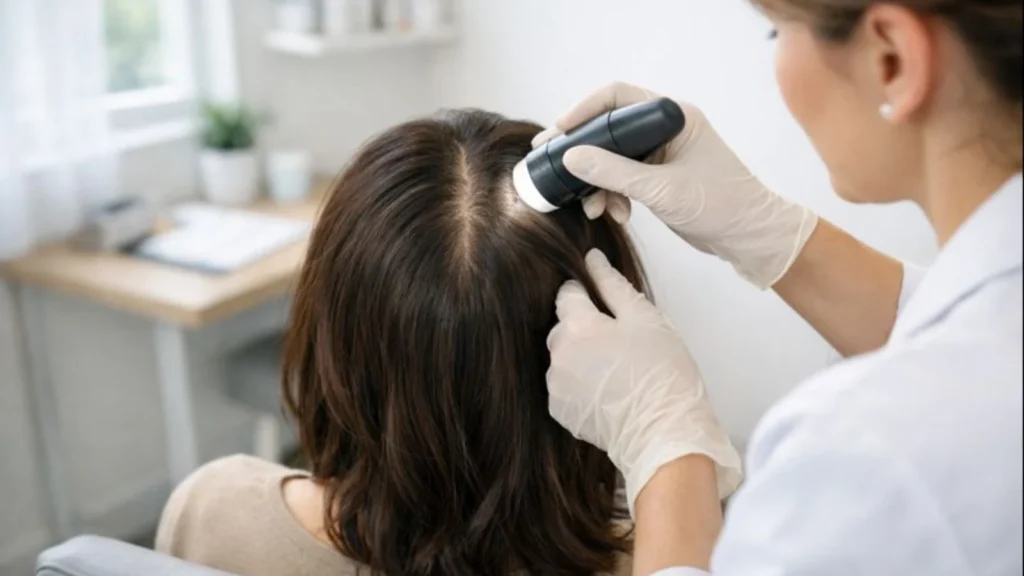
For many women, hair plays a central role in identity and confidence. When thinning begins, it can feel distressing and confusing, particularly when the cause is not immediately clear. In women living with Polycystic Ovary Syndrome (PCOS), hair changes are rarely just cosmetic. They are often a visible sign of an underlying endocrine imbalance affecting the hair growth cycle.
Understanding the specific visual markers associated with PCOS-related hair loss — including the well-recognised “Christmas Tree” pattern — is essential for early clinical assessment and long-term hair preservation.
How PCOS Affects Hair Growth
PCOS is characterised by elevated levels of androgens, male-type hormones such as testosterone. While androgens are naturally present in all women, excessive levels can negatively affect scalp hair follicles in those who are hormonally sensitive.
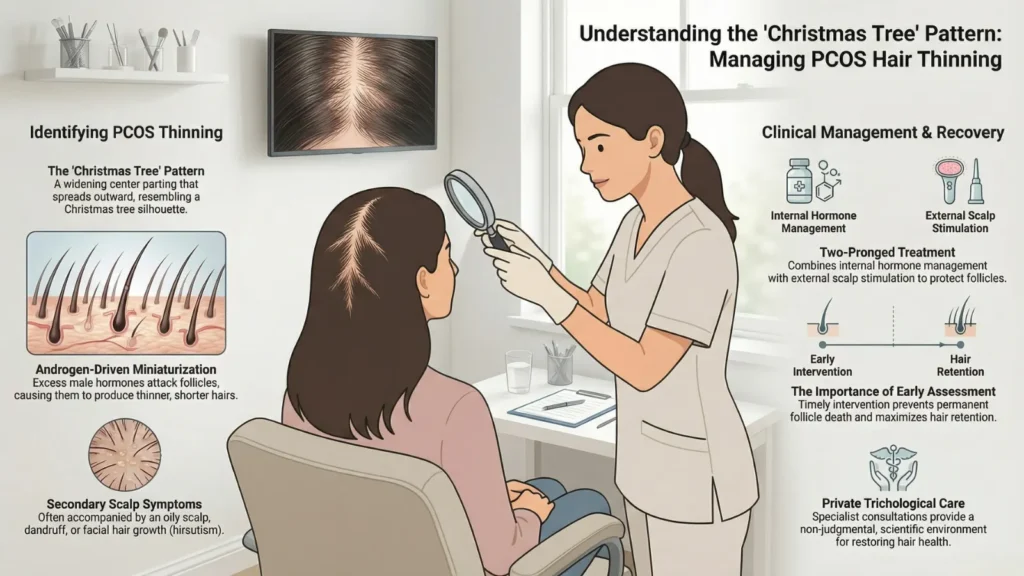
This process leads to follicular miniaturisation, where hair follicles gradually shrink and produce progressively finer, shorter hairs. Over time, this results in reduced hair density rather than sudden shedding. Clinically, this presents as a hormonally driven form of female pattern hair loss, accelerated by the endocrine environment associated with PCOS.
Visual Marker 1: The ‘Christmas Tree’ Pattern
One of the most recognisable visual signs of androgen-driven thinning in women is the “Christmas Tree” pattern. This does not involve patchy baldness or clumps of hair loss. Instead, it refers to a gradual widening of the central parting.
When viewed from above, the parting becomes noticeably broader at the front of the scalp and narrows towards the crown, forming a triangular shape similar to a Christmas tree silhouette. This pattern reflects diffuse thinning across the mid-scalp while often preserving the frontal hairline — a presentation frequently observed in women with PCOS.
Visual Marker 2: Temporal Thinning at the Temples
In addition to mid-scalp thinning, some women experience temporal recession, where hair density reduces around the temples. This pattern can feel particularly unsettling, as it mirrors elements of male-pattern hair loss.
Because temporal thinning alters facial framing, it often has a disproportionate emotional impact and is a common reason women seek professional trichological assessment. In PCOS, this presentation typically occurs alongside other androgen-related symptoms rather than in isolation.
Associated Scalp and Hormonal Signs
PCOS-related hair thinning is rarely an isolated symptom. Excess androgens also stimulate sebaceous (oil) gland activity, meaning women may experience:
- Oily scalp and hair roots
- Scalp flaking or dandruff
- Acne
- Increased facial or body hair growth (hirsutism)
This combination — thinning scalp hair alongside increased hair growth elsewhere — is a key indicator that hair loss is hormonally mediated rather than purely genetic or stress-related.
Why Early Assessment Matters
PCOS is a lifelong condition, often diagnosed in early adulthood. While hair loss linked to PCOS can be managed, timing is critical. Prolonged androgen exposure can lead to permanent follicular miniaturisation, where hair follicles become inactive and are no longer capable of producing healthy hair.
Early trichological assessment allows for:
- Accurate identification of the thinning pattern
- Differentiation between PCOS-related loss and other causes of hair loss
- Protection of vulnerable follicles before irreversible damage occurs
Managing PCOS Hair Thinning: A Clinical Approach
Effective management requires a coordinated approach. Internally, hormonal balance is typically addressed in collaboration with a GP or endocrinologist. Externally, targeted scalp therapies aim to support follicle function and reduce the impact of androgen sensitivity at scalp level.
At Sussex Hair Clinic, we support women across Sussex and Kent, including Tunbridge Wells and Eastbourne, with evidence-based assessment and long-term management plans. Our focus is on early intervention, follicular protection, and realistic outcomes, helping women retain existing hair density and stabilise further loss.If you recognise signs such as a widening centre parting, temple thinning, or oily scalp changes alongside PCOS symptoms, seeking a professional assessment is the most effective first step toward protecting your hair and restoring confidence.